Who Actually Gets Rich From Energy? (Part 1 — The Question)
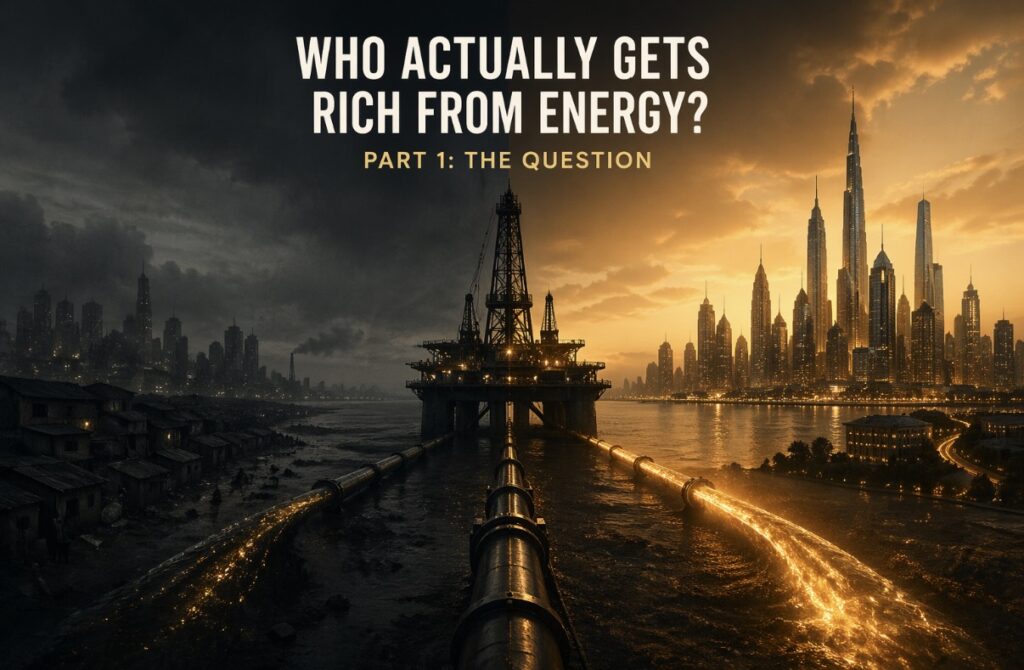
Same oil.
Same gas.
Completely different outcomes.
Some countries get richer when energy prices rise.
Others don’t.
That’s the part most people don’t question.
Over the past few years — driven by crises, conflict, and global instability — energy prices have surged across the world.
In Europe, gas prices increased by more than 400% at their peak during the 2022 energy crisis.
In the UK, household energy bills rose sharply, with the average annual bill jumping from around £1,200 to over £2,500 within a short period.
At the same time:
- Major energy companies reported record profits
- Oil-producing nations saw huge increases in revenue
- Governments scrambled to respond
So the obvious assumption is:
When energy prices rise, the country benefits.
But that’s not always what happens.
Take a step back.
If a country has oil or gas, it should be simple:
- Extract it
- Sell it
- Keep the money
Right?
That’s how most people think about energy wealth.
Resources equal wealth.
But the reality is more complicated.
Because having energy is one thing.
Keeping the value from it is something else entirely.
In some countries, rising oil prices translate directly into national wealth.
Government revenues increase.
Public funds grow.
The benefits — at least in part — stay inside the country.
In others, the outcome looks very different.
Energy is extracted.
Sold globally.
Profits are generated.
But the wealth doesn’t fully stay where the resource comes from.
Instead, it flows:
- to private companies
- to international investors
- to global markets
So the real question isn’t:
“Does a country have oil?”
It’s:
Who actually controls what happens next?
Because energy systems are not neutral.
They are built.
They are structured.
And they determine:
- who owns the asset
- who controls production
- who captures the revenue
Those three things — ownership, control, and revenue — shape everything.
They decide whether:
- rising prices benefit the public
- benefit shareholders
- benefit a small group
- or leak out of the country entirely
That’s why two countries with the same resource can end up in completely different positions.
One builds national wealth.
The other sees value extracted — but not fully retained.
And once you see that, the question changes.
It’s no longer about geology.
It’s not about luck.
It’s not even really about energy.
It’s about systems.
So before looking at specific countries, we need to understand one thing:
What happens when a country controls the system — and when it doesn’t.
Next → Part 2: Saudi Arabia